 Darkrai Lair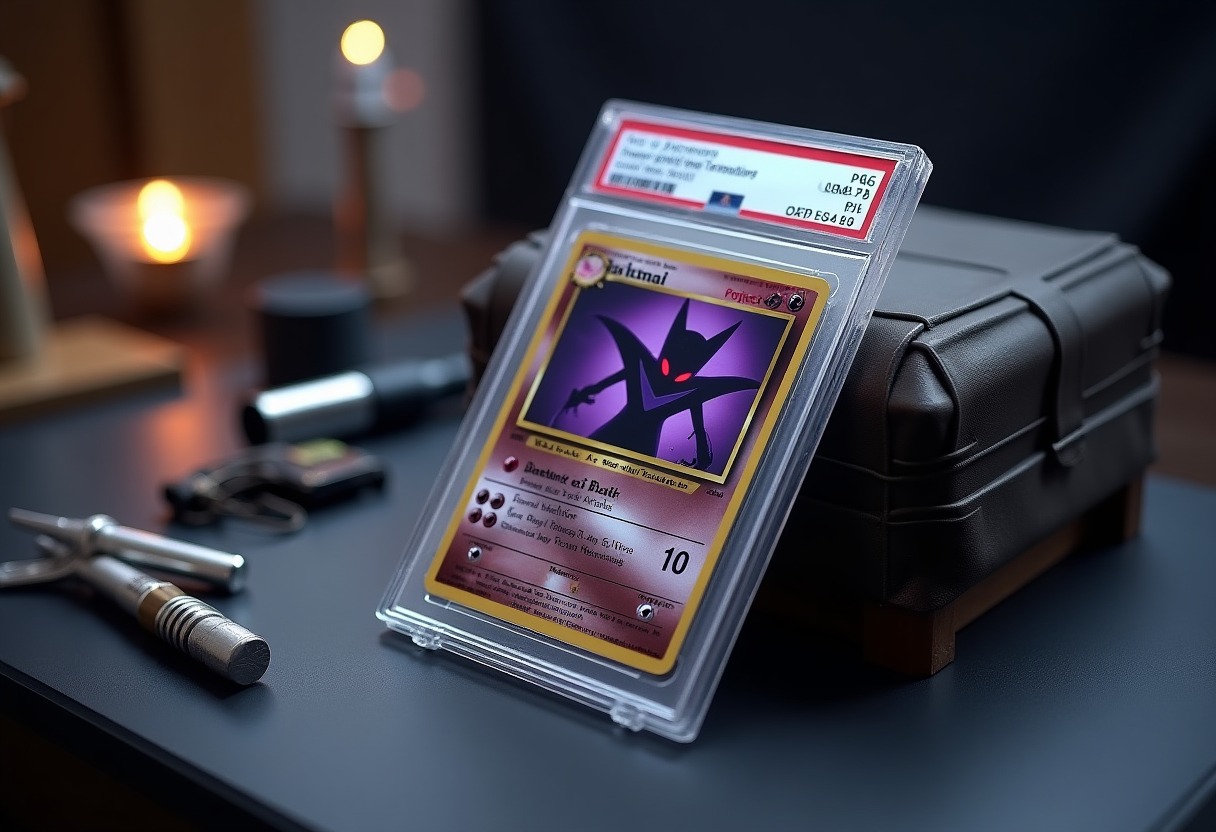
Your Darkrai VMAX alternative art from Astral Radiance just arrived raw from a booster box. The centering looks tight, no surface scratches under magnification, corners sharp enough to draw blood. Now comes the decision that affects resale value by hundreds of dollars: PSA or BGS?
Why Grading Matters More for Darkrai Than Most Pokémon
Darkrai cards carry premium value in the dark-type collecting community. The nightmare Pokémon's iconic status — solidified through its cinematic role and competitive viability — means pristine copies command serious money. A PSA 10 Darkrai & Cresselia LEGEND (bottom half) sells for $400-600 more than ungraded near-mint copies. That spread widens dramatically for older releases like the 2007 Great Encounters Darkrai.
Grading serves three purposes: authentication (counterfeit protection), preservation (professional encapsulation that prevents damage), and value certification (documented condition that buyers trust). For investment-focused collectors, graded copies offer liquidity — they sell faster and at predictable prices compared to raw cards where condition disputes kill deals.
The dark backgrounds on most Darkrai cards make edge wear and surface scratches brutally visible. A 60/40 left-to-right centering issue that might earn a 9 on a lighter card can drop a Darkrai to an 8. Before you submit anything, grab a → Shop trading card magnifying loupe on Amazon and inspect under direct LED light. Surface defects invisible to naked eye will crater your grade.
PSA Grading for Darkrai Cards: Population Control and Market Recognition
PSA (Professional Sports Authenticator) dominates the Pokémon grading market with roughly 60% market share. Their population reports — public databases showing how many copies of each card achieved each grade — create rarity data that drives secondary market pricing. A Darkrai card with only twelve PSA 10 copies in existence commands premiums far beyond cards with 200+ gem mint examples.
PSA uses a 10-point scale where 10 represents "Gem Mint" condition. For Pokémon cards, PSA tends toward slightly more forgiving centering standards than BGS — accepting 60/40 front centering for a 10, versus BGS requiring 55/45. This matters enormously for older Darkrai releases from Diamond & Pearl era sets, where centering quality control varied wildly.
Current PSA turnaround times run 20-40 business days for bulk submissions (20+ cards at $19.99 per card) and 10-15 business days for regular service ($45 per card). Express service ($150 per card) delivers 3-5 business days but only makes financial sense for cards worth $500+ raw. Check the PSA grading page for current pricing tiers.
The PSA holder design — a simple rectangular slab with minimal branding — lets the card shine. For visually dramatic cards like the Darkrai alternative art variants, this matters. The label provides grade, certification number, and card details without overwhelming the artwork.
BGS Grading for Darkrai Cards: Subgrades and Black Label Dreams
Beckett Grading Services (BGS) offers something PSA doesn't: subgrades. Each BGS-graded card receives four separate scores — centering, corners, edges, and surface — that combine into the final grade. A BGS 9.5 with four 9.5 subgrades (called a "Quad 9.5") sells for significantly more than a standard 9.5 with mixed subgrades like 9-9.5-10-9.5.
The holy grail: BGS 10 Black Label, requiring perfect 10 subgrades across all four categories. Only 0.1-0.3% of submissions achieve Black Label status. A Black Label Darkrai VMAX alternative art would command $3,000-5,000 versus $800-1,200 for a standard BGS 10. The black border on the label creates immediate visual distinction in photos and auctions.
BGS applies stricter standards than PSA, particularly for centering. That 60/40 centering PSA accepts? BGS caps it at 55/45 for a 10, with 50/50 heavily preferred. For high-value vintage Darkrai cards where centering issues are common, this frequently means the difference between a 9 and a 9.5 — and hundreds of dollars in value.
Turnaround times run longer: 25-50 business days for standard service ($30 per card), 15-20 days for express ($65), and 5-7 days for premium ($150). Unlike PSA, BGS accepts international submissions directly, though shipping costs from outside North America can approach $100.
PSA vs BGS: Direct Comparison for Darkrai Collectors
| Factor | PSA | BGS | |--------|-----|-----| | Centering Tolerance (for grade 10) | 60/40 front, 75/25 back | 55/45 front and back | | Market Recognition | Broader buyer base, easier resale | Subgrades appeal to high-end collectors | | Average Price Premium (9.5/10 grade) | 40-60% over raw | 50-80% over raw; Black Label 300-500% | | Population Transparency | Public searchable database | Population reports behind paywall | | Holder Design | Minimal, card-focused | Bolder label with subgrade display | | Best For | Vintage Darkrai with minor centering issues | Modern pulls with near-perfect attributes |
For competitive Darkrai deck builders looking to grade playable cards for collection insurance, PSA makes more sense — lower cost per card, faster turnaround, and adequate protection. For collectors assembling museum-quality Darkrai EX and GX collections, BGS provides the granular grading data that justifies premium pricing.
One often-overlooked factor: holder thickness. PSA slabs measure 9mm thick versus BGS at 10mm. When building display cases or card storage binder pages, that 1mm difference compounds. A 100-card BGS collection requires noticeably more space than the PSA equivalent.
Submission Best Practices: Protecting Your Darkrai Cards
Never submit a card raw without proper protection. The grading process involves multiple handlers, shipping both directions, and mechanical insertion into holders. → Shop ultra pro card sleeves on Amazon and pair them with → Shop toploader card holders on Amazon. Use penny sleeves first (opening at the top), then insert sleeve-down into the toploader.
For bulk submissions of multiple Darkrai cards from your collection, invest in a → Shop card grading submission kit on Amazon. These include pre-cut cardboard protectors, submission forms, and return shipping materials. The $30-40 investment prevents bent corners during transit — damage that would otherwise cost you the difference between a 9 and a 10.
Pre-grade your cards honestly. A card with visible whitening on back edges won't grade 10, regardless of service. Save the $50+ grading fee for cards that realistically achieve 9 or higher. Most grading companies offer photo review services ($10-15) where experts assess your card's grade potential before submission.
Timing matters for population control. Submitting a Darkrai card immediately after set release — when supply is flooding the market — adds your gem mint copy to a growing population. Waiting 6-12 months means your PSA 10 enters a smaller population pool, potentially commanding higher premiums. This strategy only works for cards you're willing to hold long-term, not quick flips.
Document everything. Photograph your cards before sleeving, during packaging, and take video of the sealed submission envelope. If grading results disappoint and you suspect holder damage or processing errors, this evidence supports appeals. Both PSA and BGS offer review services where you can challenge grades, though success rates hover around 5-8%.
What Most Grading Guides Won't Tell You
Population manipulation is real. Some high-volume submitters crack PSA 9 copies and resubmit to BGS hoping for a 9.5, or vice versa. This practice — while ethically questionable — acknowledges that grader subjectivity exists. The same card submitted to the same company twice can return different grades based on which grader handles it.
For Darkrai cards specifically, the dark artwork creates contrast that makes centering issues more visible. A Darkrai card with 58/42 centering looks worse than a Pikachu with identical centering because the dark borders draw the eye to asymmetry. If you're choosing between PSA and BGS for a borderline-centered Darkrai, PSA's more forgiving standards might net you a grade bump.
Set registry programs reward PSA submissions. PSA Set Registry lets collectors compete for highest-rated complete sets, driving demand for specific card populations. While this matters more for complete Master Set collectors than individual Darkrai enthusiasts, it creates upward price pressure on PSA 10 copies of key cards. No equivalent exists for BGS.
Insurance and shipping costs eat into profits for lower-value cards. Grading a $30 raw Darkrai makes no sense when fees and shipping total $45-70. Focus grading efforts on cards worth $100+ raw, where the grade premium justifies expenses. For budget Darkrai merchandise and common printings, raw near-mint copies serve collectors perfectly well.
Consider hybrid strategies. Grade your crown jewel cards (alternative arts, vintage holos, valuable Darkrai variants) with BGS for the subgrade prestige. Submit your high-end but not ultra-rare pulls to PSA for cost efficiency and faster turnaround. Keep your playable duplicates raw for actual gameplay in competitive Darkrai decks.
FAQ
Should I grade a Darkrai card with minor edge whitening visible only under magnification?
Don't grade cards with any visible whitening, even under magnification. Grading companies use professional loupes stronger than consumer versions, and graders specifically examine edges under intense lighting. Edge wear automatically caps your grade at 8 or lower with both PSA and BGS, meaning you've paid $50+ for a grade that adds minimal value to the card. The PSA 8 market for most Darkrai cards sits only 10-20% above raw near-mint pricing. Save your grading budget for legitimately gem mint candidates where the grade premium justifies the investment.
Does PSA 10 or BGS 9.5 command higher prices for Darkrai cards?
PSA 10 typically sells for 10-15% more than BGS 9.5 for the same card due to broader market recognition and collector preference for the PSA brand. However, BGS 9.5 with quad 9.5 subgrades often matches or exceeds standard PSA 10 pricing because the subgrade transparency proves the card barely missed a perfect 10. For vintage Darkrai cards from 2007-2010, PSA 10 dominates pricing because centering issues make BGS 10 nearly impossible. For modern Darkrai releases with tighter quality control, BGS 9.5 Quad represents better value per grading dollar since it's easier to achieve than BGS 10 but commands strong premiums.
How long should I wait after pulling a Darkrai card before submitting for grading?
Submit immediately if you're pursuing population advantage (being among the first PSA 10 copies drives premium pricing), or wait 6-12 months if you're prioritizing rarity. Recently released sets flood the grading pipeline with hundreds of submissions, inflating population counts and suppressing gem mint premiums. Waiting allows print runs to exhaust, reducing raw supply and creating scarcity for graded copies. This strategy backfires if the card's value drops due to meta shifts or reprints, so only delay grading for cards with strong long-term collecting demand like alternative art Darkrai variants or cards tied to Darkrai's lore significance.
Can I submit Darkrai cards from Japanese sets to PSA and BGS?
Both services accept Japanese Pokémon cards with no restrictions, but label formatting differs. PSA labels Japanese cards with the Japanese set name and card number, which some collectors prefer for authenticity. BGS provides English translations on labels, making listings clearer for international buyers. Japanese Darkrai cards from vintage sets like DPt-P Promos or Movie Commemoration sets often achieve better grades than English equivalents because Japanese printing quality typically shows superior centering and surface consistency. Factor in longer shipping times (10-15 days each direction) and customs potential when submitting international cards. For more on Japanese TCG cards, TheTCGSlayer covers investment angles.
Should I crack a PSA 9 Darkrai card and resubmit hoping for a 10?
Only crack and resubmit if the card's raw value exceeds $200 and you've identified specific grade limiters you can improve. Cracking destroys the PSA holder and voids the original grade, meaning resubmission risks returning a lower grade or damage during the cracking process. Review your PSA 9 under magnification — if the only issue is borderline centering (59/41) or a single micro-scratch, resubmission to BGS might net a 9.5. If corners or edges show wear, the card will never achieve 10. Calculate break-even: if a PSA 10 sells for $300 and your PSA 9 sells for $180, you need $120+ spread to justify the $50 resubmission cost plus risk of getting another 9.
Making the Grade Decision
Choose PSA for vintage Darkrai cards with centering quirks, bulk submissions of mid-tier pulls, and cards you plan to sell quickly. Choose BGS for near-perfect modern releases, cards where subgrade documentation justifies higher pricing, and collection centerpieces where Black Label potential exists. Most serious Darkrai collectors maintain both PSA and BGS examples because different buyers prefer different holders.
Some links on this page are affiliate links. We may earn a small commission if you purchase through them, at no extra cost to you.
As an Amazon Associate we earn from qualifying purchases. This article contains affiliate links; if you buy through them we may earn a small commission at no additional cost to you.